Ground improvement in McKinney, Texas, encompasses a suite of engineering techniques designed to enhance the mechanical properties of soil and prepare sites for safe, long-lasting construction. As this city within Collin County continues to expand rapidly, the demand for reliable foundations on the region's challenging soils has never been greater. This category covers methods that increase bearing capacity, reduce settlement, and mitigate liquefaction potential, ensuring that commercial buildings, residential subdivisions, and public infrastructure perform as intended. Without proper ground improvement, structures on the local expansive clays and loose alluvial deposits risk cracking, differential movement, and even catastrophic failure over time.
The local geology plays a decisive role in why improvement is essential here. McKinney sits on the Eagle Ford Group and Woodbine Formation, which produce stiff, overconsolidated clays interbedded with sands and silts. These soils undergo significant volume changes with moisture fluctuations, a phenomenon that wreaks havoc on shallow foundations. Additionally, areas near the Trinity River tributaries contain recent alluvium and fill materials that are loose and compressible. Understanding this stratigraphy is the first step in selecting an appropriate improvement strategy, whether through densification, reinforcement, or drainage.
Regulatory compliance in McKinney follows the 2021 International Building Code as adopted by the State of Texas, supplemented by local amendments from the City of McKinney's Engineering Design Standards. These documents mandate minimum allowable soil bearing pressures, settlement limits, and safety factors that directly influence ground improvement design. Geotechnical reports must be sealed by a licensed Professional Engineer in Texas, and the Texas Board of Professional Engineers and Land Surveyors governs practice standards. Adhering to these codes ensures that any improvement technique meets the performance criteria required for permitting and long-term structural integrity.
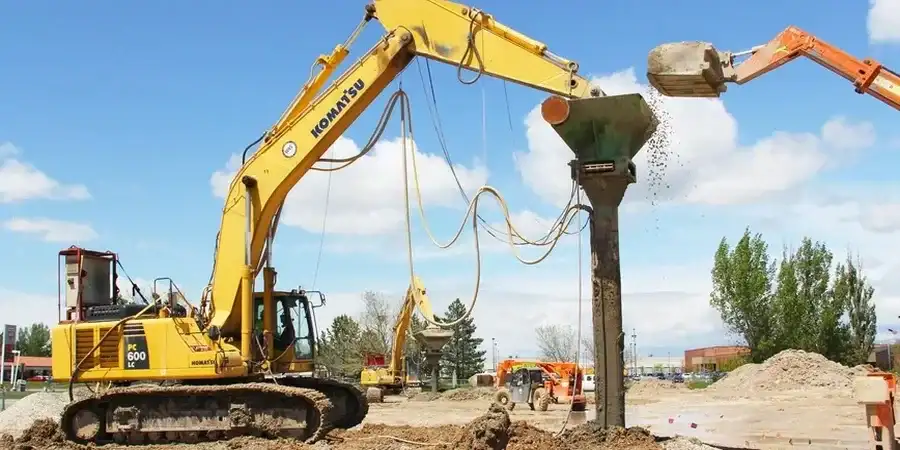
Projects that commonly require ground improvement range from big-box retail developments and warehouse facilities to multi-story office buildings and municipal works. For sites with thick deposits of soft clay, designers may turn to stone column design to create stiff, drained inclusions that transfer loads to deeper competent strata. When loose granular soils dominate the profile, vibrocompaction design offers a proven method to densify in-place materials and reduce settlement risks. Even smaller projects like retaining walls, embankments, and pavement subgrades benefit from targeted improvement to avoid costly maintenance down the road.
Available services
Quick answers
What is ground improvement and why is it necessary in McKinney?
Ground improvement refers to engineering methods that modify soil properties to increase strength, reduce compressibility, or control permeability. In McKinney, expansive clays and loose alluvial soils create settlement and swelling hazards that can damage foundations and pavements. Improvement techniques mitigate these risks, ensuring structures meet performance standards under local conditions.
How do I know if my McKinney site needs ground improvement?
A geotechnical investigation is the definitive way to determine need. Borings and lab tests reveal soil stratigraphy, strength, and consolidation characteristics. If results show low bearing capacity, high settlement potential, or expansive minerals, a qualified engineer will recommend improvement. Sites near creeks or with deep fill are particularly susceptible.
What local regulations govern ground improvement in McKinney?
The City of McKinney adopts the International Building Code with local amendments, enforced through its Engineering Design Standards. These require geotechnical reports sealed by a Texas-licensed engineer. Improvement designs must demonstrate compliance with safety factors, settlement limits, and bearing capacity minimums specified in those codes.
What types of projects in McKinney typically require ground improvement?
Commercial buildings, warehouses, residential subdivisions, and infrastructure like bridges and retaining walls often need improvement. Any structure on problematic soils—expansive clay, loose sand, or uncontrolled fill—can benefit. The scale ranges from small pad sites to large distribution centers, wherever subsurface conditions threaten long-term performance.
Location and service area
We serve projects across McKinney Texas and surrounding areas.